Monday, November 21, 2011

Dinner on the Fly: Chinese Hot Pot in an American's Kitchen

Something about this dish will be lost in translation.  My first experience with food and culture in China and Hong Kong has brought me a deeper understanding of both, if not a full one.  I must have tried forty  dishes during my stay and each one was completely different from the last.  Still, I haven't made more than a small dent in understanding the vastness and complexity of Chinese cuisine. There are flavors that I will always remember and look forward to, should I return, not just for the their flavors but for their unique and artful presentation.  Should I return to Hangzhou, I will want to unwrap the lotus leaf that a whole spring chicken has been cooked in to release the fragrant steam and make sure the head is still intact.  I'll ask for the pot of shrimp brought live to the table, then drowned in rice wine so that their fresh water taste mingles with the sweet acidity.  I would like at least two different green vegetables, cooked to a just wilted bright green, pleasantly salting and tinged with garlic.  Let me not forget to accompany it with a cup of Dragon Well green tea, where the leaves float like plants behind an aquarium's glass and it tastes the way grass smells in Spring.

Is that what comes to mind when you think of Chinese food? If it is than you win the cigar for for being far more worldly in t the realm of Asian culture than I.

Traveling to a new place and breaking bread with locals was like a reboot to the way I think about food. Hot pot was one of my favorite dishes in China and Hong Kong.  It epitomized the family style way of dining where a dish is always shared and brought to the table when ready, without our western concept of a sequence of courses.  Hot pot was also one of the simplest dishes in concept.  Perfect for the non-Asian-savvy to recreate at home.  It isn't only an ease of preparation and flavors from my trip that I am bringing to my table with this dish, but the intimate circle it creates as we all share in the cooking and tasting of our meal.

Not to mention it reminds me of a fondue party, which I love.


This is a hot chili oil I made by heating peanut oil with garlic cloves and lots of tian jin red chilis. 


Hot Pot (With a Little of Everything Thrown In)

For the broth: 
  • 1 lb pork bones
  • 10 garlic cloves, peeled and mashed with the flat side of a knife
  • 1 small yellow onion, chopped
  • three carrots cut in rounds
  • 1 small knob of ginger, chopped to equal about 2 tablespoons
  • 5 small potatoes, diced (preferably yellow flesh)
  • 4 diced scallions
  • 2 tablespoons soy sauce
  • 2 tablespoons fish sauce
At the table:
  • very fresh, thinly sliced raw top round beef (or substitue and appropriate cut of pork or lamb)
  • very fresh, filet of flounder cut into small bite sized pieces (or substitute another white fish)
  • very fresh, sliced scallops (or shelled and cleaned shrimp)
  • chopped shitake mushrooms
  • snow peas (or bok choy)
Dipping sauce:
*simple soy sauce is fine here.  I went to one restauraunt and there was a make your own dipping sauce bar so I tried to recreate what I did which was delicious.  I did not measure I just added buy taste
  • soy sauce
  • peanut butter
  • fish sauce
  • minced garlic
  • minced scallion (green parts only)
  • 1 minced dried red tian jin chili

    In a large stock pot, add pork bones, chopped onion, garlic, carrots, ginger and potatoes.  Bring to a boil.  Keep at a gentle boil uncovered for 1 1/2 to 2 hours.  You want about a fourth of the liquid to reduce.  While still boiling add your soy sauce, fish sauce and scallions.  You want to keep this soup as close to boiling heat as you can because you are cooking ingredients in it at the table.

    The rest of this recipe happens at the table.  It is in the layout.  I used fondue pots to keep the soup at a temperature that cooks your ingredients.  Then I ladled soup into individual small bowls for sampling.  Dipping sauce was in everyone's reach. I made sure my meat and fish were cut small so that it cooked at the end of our chopsticks.  Vegetables were added by the handful, pulled out and served when bright and tender.  It was awkward at first but we got the hang of how and when to reach over one another, whether we dipped our fish, meat or vegetable into the sauce or added the dipping sauce into the bowl and how long to hold our raw ingredients in the hot broth.  Like any firsts, we got the hang of it.

Friday, November 11, 2011

Fundraiser Brunch: Recipes and Thanks

I have been thinking a lot about what it means to make positive contributions to the world we live in.  That being said I have been wondering in what way I can use my own skills to do that.  What does it mean to live a life that is conscientious in addition to one that balances our joys and our survival?

So my dear friend, Janice and I made a recent call out to the internet universe (and a few neighborhood establishments) that we were holding a fundraiser brunch to raise money for the Food Bank of NYC.  Food for food, so to speak.  As promised in our menu, below are the recipes of the food we served as well as some photos of the event.  Hope it inspires, both cooking and kindness.

I want to thank all of you who came out to donate to the cause and show your support for Food Bank of NYC (and for Janice and I).  Thanks also to Veronica People's Club that allowed us to use their space.


Clementine Blackberry Compote
  • 10  peeled and sectioned clementines
  • 1 quart blackberries
  • simple syrup (1/2 cup sugar, 1/4 cup water
  • orange juice (1/2 cup orange juice)
This is a simple fruit salad with and orange dressing.  Simple syrup is 2 parts sugar to 1 part water.  Bring your water to a boil.  Once boiling add your sugar stirring constantly until dissolved. Remove from heat and add orange juice.  Allow to cool before adding to your fruit for a lighter fresher fruit salad.  Or add your fruit to the dressing and cook until their juices are released and serve warm.  Great over yogurt.


White Bean Chowder
  • slab bacon
  • 1 large onion
  • 2 teaspoons dry or 1 sprig fresh rosemary
  • 16 ounces dry white beans, soaked and cooked until soft
  • diced white or yukon gold potatoes
  • salt
  • pepper
  • 2 tablespoons olive oil 
  • 5 inckh square of cheese cloth
  • 1 quart chicken broth
In a large soup pot or dutch oven, sautee bacon in olive oil until crispy. Add onions and cook on medium in rendered bacon fat until transluscent. Put your rosemary in a the center of cheese clothe square and tie securely.  Add your broth, cooked white beans, potatoes and rosemary pouch.  Add water to adjust the thickness of your soup.  Cook until the potatoes are tender.

Salad with Red Grapes and Walnuts

  • 1 head of red or green leaf lettuce (or a mixture of both)
  • 3/4 cup red seedless grapes halved
  • 1/4 cup chopped walnuts
  • olive oil
  • white wine vinegar
  • salt pepper
Wash and dry lettuce completely.  Cut along the vein of the lettuce so that you have two halves.  Then cut in horizontal bite-sized peices.  Toss with grapes and walnuts. Dress lightly with oil, vinegar, salt and pepper.

Fritatta with Goat Cheese and Dill 
or

Parsley, Sundried Tomato and Salami 
  • 6 eggs beaten
  • chopped parsley or dill
  • 2 small potatoes sliced on the thinnest setting of a mandolin
  • minced sundried tomato, crumbled goat cheese or genoa salami sliced in small strips
  • salt
  • pepper
Preheat your oven to 375 degrees.  Heat your oil in a 9 inch cast iron skillet.  Once your olive oil is hot but not smoking layer your potato slices in the hot oil, salting lightly in between the layers.  Cover and cook on medium low heat until the potatoes are tender. Add your eggs.  Once they have set on the bottom, scatter your herbs, cheese, tomato or salami (essentially whatever you are using to flavor your fritatta)  across the top. Add salt and pepper to taste.  Cook a little longer until the sides of your fritatta begin to set.  Then transfer into the oven.  Bake until the center sets.


Baked Pecan French Toast with Honeyed Yogurt


We used a recipe from Ezra Poundcake.  If you haven't been to this blog yet you should definitely check it out!

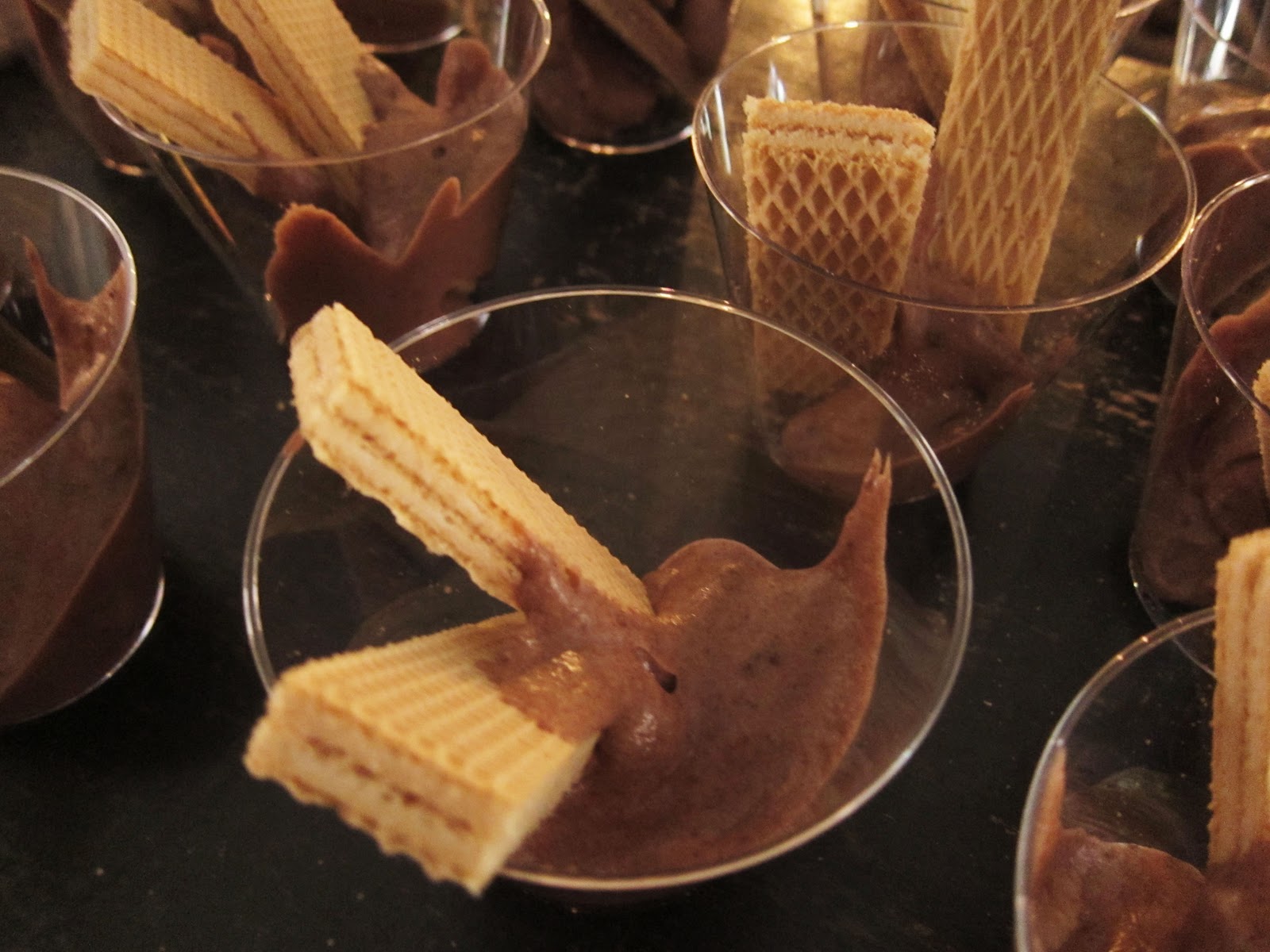
Chocolate Mousse


This is strictly a Mark Bittman's recipe.   


Monday, November 7, 2011

Printable Weekly Menu Planner Giveaway!


Happy Fall!

So here is how you can print your weekly meal planner below:
  1. Double click on the image below.
  2. Then right click and you should see a window of choices.
  3. Select print.
or
  1. Double click on the image below.
  2. Click on File tab
  3. Select print.

Monday, October 17, 2011

Harvest Fundraiser

  My dear friend, Janice and I will be cooking a fundraising luncheon to help raise money for the Food Bank of NY.  Come eat some good food and help someone else eat at the same time.  If you read this blog and you a local, or visiting we hope you join us!

Thursday, October 13, 2011

Wrappings and Fillings - The Origami of a Potsticker

Gone are the days of traveling with a passport, a paper map and a change of underwear.  In packing for my two week trip, destination Hong Kong and China mainland. I have triple checked that I have my laptop, camera, chargers, magic jack, Tylenol PM, and an unheard of four pears of shoes.  Clearly traveling light means something different to me now then it did a carefree decade ago.

Despite having to pack and prepare for this journey, I was inspired by Heidi Swansons's post "Golden Pot stickers"  on her blog 101 Cookbooks.  Maybe it because of the Asian influence or maybe it was because she also was preparing for a flight that I was moved to making pot stickers before this trip  (Once again I leave my kitchen a mess at a very inopportune time.)  In this post I will recommend that you try Heidi's recipe that looks practiced, well-tested and tantalizing.  Mine was, in fact, a disaster.  Let me apologize if you came to this site in search of a recipe and instead found me droning in about the current up sweep of my life and how it connects with the joy I find in the craft of making food.  In my defense I tried to write a fabulous recipe for you, one indicative of this new culture that I am traveling to.....a culture that I know little to nothing about.  That was the problem.

I made the filling for these pot stickers the way I would have made a ravioli, a vegetable, tofu ravioli.  I was drawing on my own knowledge about cooking and cuisine and this time I fell short.  The effect was bland and mushy with the faintest hint of what I assumed to be Asian flavors:  ginger, scallions, soy sauce, shitake mushrooms  Like an ethnic stereotype, it was an incomplete, inaccurate representation of what a real Asian food experience could be.  Food without that deeper complexity is just filling your stomach.

Not everything I make is a success, design, food, or writing, but what I have come to know is that the process is what keeps me going just as much as the desired result.  There was a calm that cam over me in folding these wrappers into neat little four-cornered envelopes, trying to get each one more perfect than the last.  A talented artist friend of mine, Jaclyn, told me that when she feels anxious about something she folds origami paper cranes.  There are beautiful bowls full on of them on display in her home.  (Was I anxious?  Could have been the 14 our flight ahead of me.)

Anyway, I will probably be too busy to see many of the tourist sites on this trip but I do hope I come away with a more authentic idea of Chinese cuisine than what comes in the little white cardboard boxes in New York.    Maybe then you will get your recipe.


Monday, October 10, 2011

Accompaniments: Pickled Serrano Chili Peppers


Usually, when I am making a dish that requires a hot pepper I only need one or two at a time.  But then there I am at the supermarket and all I see are packages of hot peppers.  There just isn't a way that I will use up 20 serrano peppers this week.  But I can pickle them to use later!  I always have a jar of pickled hot peppers in my fridge and I use them in place of the fresh ones in any recipe that calls for one.  They tend to be less hot but still very flavorful. 


Pickled Serrano Peppers

  • 1 lime cut in eighths
  • 1 clove of garlic sliced or quartered
  • as many chili peppers as you can fit in a jar
  • 1 teaspoon cumin
  • 1 teaspoon coriander seed
  • 3 tablspoons salt
  • white vinegar
Add lime, peppers, garlic, spices adn salt to a 16oz sterilized mason jar.  (To sterilize a jar and lid, place them in a pot of boiing water for 10 minutes.  Add vinegar until it rises above one fourth of the jar.  Fill the rest of the jar up to the lip with water so no air gets in.  They are ready to go after about 2 days.


Thursday, October 6, 2011

Sunday Dinner at Home: Roasted Acorn Squash Ravioli


Let me start by saying that I do not have a pasta machine.  I have never had one and I am pretty sure my grandmother didn't either.  Saying that doesn't mean that I am opposed to one.  I didn't mean that in the belligerent I-will-never-have-one-and-you-shouldn't-either kind of way.  Quite the contrary, we would probably have fresh pasta more often if I did have a pasta machine.  But you can make fresh pasta without one and it isn't as hard as you think.

Do you remember what it was like to want to get your hands dirty?  Or to be a kid and need the satisfaction of a tactile experience?  I could not pass a pile of leaves my father had just raked without jumping in it.  How about running your fingers through warm sand and digging down to the cool, damp sand underneath?  When I was an art teacher my students would ask "When do we get to use clay?" starting on the first week of school and every week that followed until we actually did use clay.  They would cheer on painting day from kindergarten to high school.

That is the joy of making something from scratch.  It literally feels good.  Like cold water and wet clay on a potter's wheel...someone stop me because I will go on forever.  Pasta making is like that too except afterwards you get to eat it!  If you are really nice you might even share it with others.  So what if it took me all day and my kitchen was a mess?  Maybe my furniture, counters, hair and eyebrows are covered in flour, but I had fun.  Delicious fun.


Roasted Acorn Squash Ravioli with Fried Sage Leaves 
For the pasta:
  • 3 eggs
  • approx. 3 cups of flour
For the filling:
  • 1 acorn squash
  • 1/4 cup diced pancetta
  • 1 tablespoon butter
  • 1 small or half of one large onion diced
  • 2/3 cup Parmesan cheese
  • 5 sage leaves chopped
  • salt
  • pepper
For the garnish:
  • 3 tablespoons of butter
  • remaining bundle of sage leaves

Preheat your oven to 400 degrees.  Wrap your acorn squash in aluminum foil and pop it in.  This will roast for about an hour and a half.

On a clean dry surface, scoop out your flour and make it into a pile (like a mountain, as my aunt would say).  With your fingers, make a hole in the center (like a valley, if you will).  You want to make sure this hole goes down to the surface and that the "walls" are pretty high.  Crack one of the eggs into the center of your flour. Gently scramble the egg with a fork.  it will begin to absorb the flour.  When it becomes more of a cough you can begin to knead it with your fingers.  Form the dough into a disc and repeat with the following two eggs.

On a floured surface, roll out your dough from the center out.  The flour is what makes the dough expand so if the dough is too sticky or not spreading, add more four to the surface.  Roll out the dough as thin as you can get it without breaking.

In the meantime, you might want to get started on the filling.  Add your butter, pancetta and onion to a hot skillet.  Turn down the heat to medium and sautee` your ingredients until your pancetta is well cooked and your onion is translucent.  Salt and pepper to taste

When your acorn squash is done, take it out, unwrap it, cut it in half and let it cool.  When it is cool  enough to handle, scoop out the seeds and throw them away.  Then scoop out the flesh with a spoon. Add the squash, pancetta and onion mixture, chopped sage and Parmesan cheese to a food processor and pulse until smooth.  (Or mash it together with a fork if you prefer.)

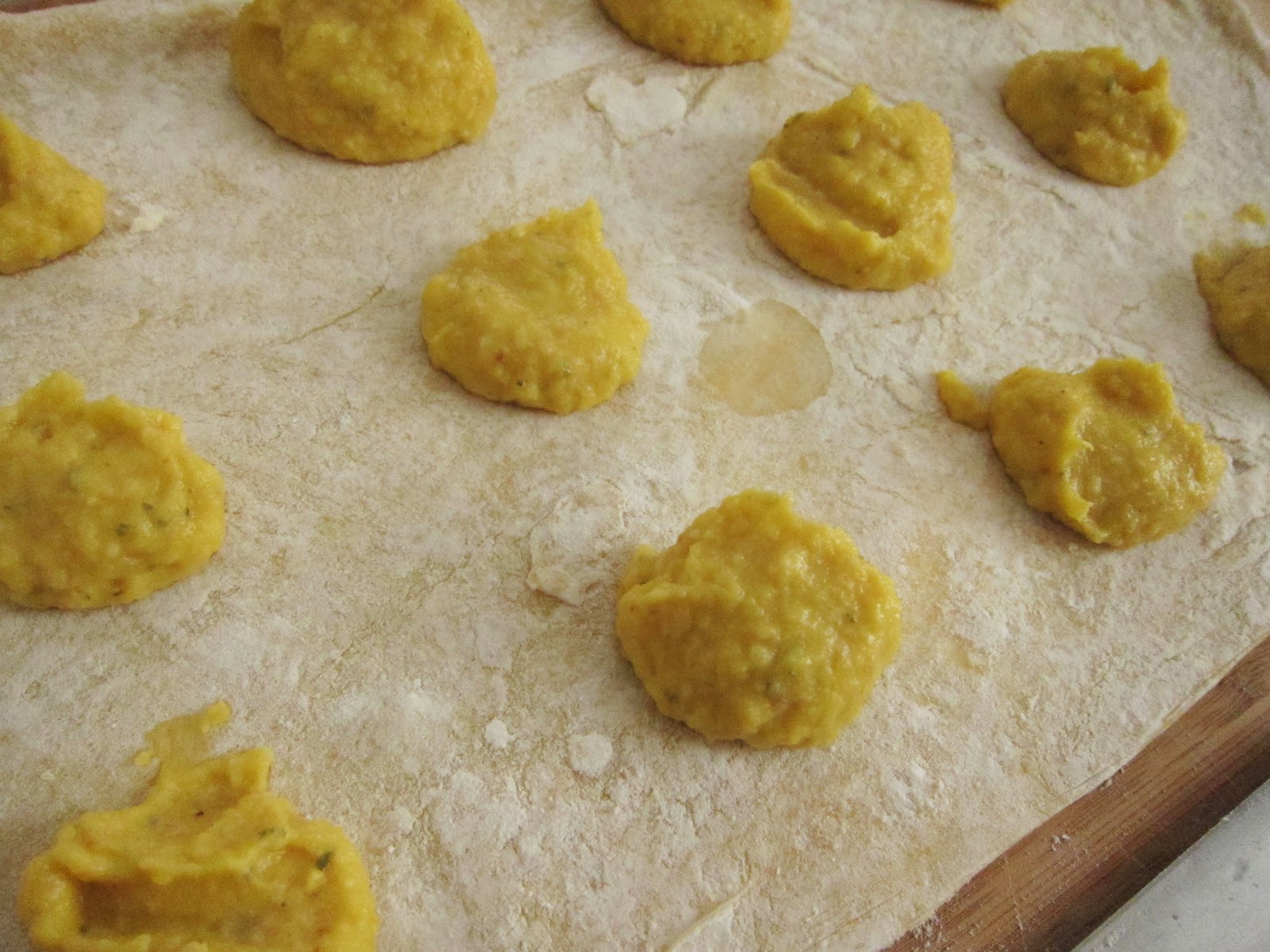
Lay out one sheet of the pasta and add a spoonfuls of your squash mixture, each about 2 inches apart. Brush a little water on the dough in between.  Lay another sheet of pasta on top and press around each lump of filling with your fingers so that the dough sticks together. Cut your ravioli apart with a knife or pizza cutter.  You want to lay the ravioli out on a tray with some space between them to keep them from sticking together before you cook them.  Boil about three or four at a time, until they float to the top and pucker slightly.

In a frying pan or hot skillet, melt about 3 tablespoons of butter.  When the butter is hot and melted but not yet brown, add the sage leaves with a generous sprinkling of salt.  Let them fry until they darken and curl.  Drizzle over the ravioli.