Showing posts with label pasta. Show all posts

Sunday, April 22, 2012

Simple Spaghetti Pie

So I have been practicing this one.  It looks good going in the pan but it is a tricky thing to turn it over.  Do I use a spatula?  Should I cover the pan with a plate, carefully turn it over and then return it to the pan?  Or do I make the gutsy choice of flipping and risk egg and spaghetti all over my kitchen?

Oh yeah,  I went for it.  Let me tell you I am proud of myself.  I shook the pan a little back and forth like marathon runner rocking to gain momentum before bolting forward.  I hurled this spaghetti upward and let go, fully prepared to have egg on my face, (pun intended).  But no, a split second later, there it was in one piece and showing me its underside.  Damn, no one there to see it.

I am talking about Spaghetti Pie, or at least that is what we call it in English.  I have heard it called by more than one name in Italian and I think that is depending on geographically where the one cooking it is from.  I remember it fondly as what we brought on picnics when I was growing up and it was always made out of our leftover spaghetti.

Thinking of trying this at home?  In the vein of full disclosure, this was not my first try.  I have tried flipping it with a spatula, a dinner plate and yes I have gotten egg all over my stove.  Here's what I learned:  it is all about your spaghetti/egg/cheese ratio. Three eggs to a pound of pasta isn't going to do it.  The best result I have gotten was when I thought I added way too much egg and cheese.  The pictures below show a simple version using some plain leftover spaghetti.  The spaghetti does not have to be plain.  That's like saying all ice cream should be vanilla.  It doesn't even have to be spaghetti for that matter.   One of may favorite versions of this dish was made by a cousin of mine from a leftover pasta salad with salmon (Thanks Clara!).  Just make sure you have plenty of egg and cheese and then you can flip it any way you like.


Simple Spaghetti Pie

  • 6 eggs
  • 1 cup grated Parmesan or Romano cheese
  • 1/4 of a pound cooked pasta (about a bowlful)
  • freshly chopped basil of parsley (optional)
  • sea salt
  • freshly ground black pepper
  • 3 to 4 tablespoons of olive oil
Beat the eggs cheese in a medium bowl with a fork or a wire whisk.  Add salt, pepper and chopped herbs if you choose to add them.  Add spaghetti to the eggs and cheese.  Heat your olive oil over medium high heat.  Remember you don't want you olive oil to get to a smoking point.  When I tip my pan and the oil runs like water it is hot enough.  Add your egg, cheese and spaghetti mixture and cook until the underside is set.  You may need to lower the heat so your egg doesn't get too brown.  When the bottom is fully cooked, cover with a dinner plate and turn your pan over with both hands (don't forget you oven mitt!) then slide back into the pan.  Or flip it in the air if you are feeling brave!  Cook until the bottom is set.  You can check the center with a fork.  If the center is dry, its done.

Thursday, March 22, 2012

Ragu Bolognese


This is one of Nick's absolute favorite dishes.  I should have written about it before now.  It is the ultimate in comfort food and a recipe I have made so often I know it in my sleep.  Particularly because I am a stickler for how it is done.  It isn't difficult or complicated but when one step or ingredient is amiss I can taste it.  

I have had some lively discussions with fellow enthusiasts of this dish as to its contents.  Some use tomato, some don't.  There have been those known to use red wine (although I prefer dry white so as not to overpower the other flavors).  Some use just beef and others use beef, veal and pork in thirds.  My brother does a great version using that variety of meat, pancetta and minus the tomato.  I always like the fresh contrast of tomato and parsley against the richness of the meat.  These ingredients are flexible but it is the liquid reductions that are important in tenderizing the meat and infusing it with flavor.  First milk, then wine and, if you like, tomato.  It is those reductions that define the difference between a meat sauce and a ragu.

This recipe will make a decent amount so you should know that it freezes well, is awesome over polenta as well as pasta and will make your lasagna unforgettable.

Ragu Bolognese
  • diced pancetta
  • 1 lb ground beef
  • 1 onion chopped
  • 2 to 3 carrots finely chopped
  • 2 celery stalks, ends trimmed and chopped
  • 2 cups milk
  • 2 cups dry white wine
  • 1 cup San Marzano tomato puree (or about half a 16 oz can)
  • freshly ground nutmeg to taste
  • 1/4 cup chopped parsley
  • 2 to 3 tablespoons olive oil
  • salt (kosher or sea) to taste
  • freshly ground black pepper to taste
  • freshly grated parmesan or romano cheese to taste
In a heavy bottomed sauce pot or dutch oven, saute` pancetta in olive oil just enough to give it color and to render some of the fat and release the flavor.  Add your chopped aromatics, onions, celery and carrots.  Saute` until soft and the onions are translucent.  Add your ground meat and cook until no longer pink, breaking it up into smaller and smaller chunks while it is cooking.  Add milk and let simmer until the milk is absorbed into the meat, about 15 minutes.  Add freshly ground nutmeg to taste.  Add wine and let simmer until it is absorbed into the meat, also about 15 minutes.  Add your tomato puree and let simmer for a minimum of 30 minutes but up to an  hour stirring occasionally.  Add parsley, salt and pepper before serving.  Serve over pasta or polenta with grated cheese. 

Monday, November 28, 2011

Dinner on the Fly: Spaghetti and Meatballs

Spaghetti and meatballs.  Do I even need to write anything else?  It is sinful and comforting, ethnic and universal.  Some version of this classic dish has been a part of almost all of our kitchens growing up.  My favorite version of it is the simplest one.  What is your recipe?  Do you make it spicy or give it a twist?

Meatballs
  • 1/2 lb ground beef, pork or veal (or a combination)
  • 1 clove of garlic, chopped
  • 1/2 an onion, chopped
  • 1 egg
  • 1/2 teaspoon oregano
  • 1/4 cup bread crumbs
  • 1/4 cup Parmesan cheese
Preheat your oven to 400 degrees.  Line a sheet pan with  parchment paper.  Put all the ingredients a food processor and pulse until blended.  Careful not to pulse too much or you will get a puree.  take about 1/2 a cup of your mixture (small snowball size ) and roll into a ball.  Place each one on the parchment paper lined pan about 2 inches apart.  Keep a bowl of water nearby to dip your hands in so that the meat doesn't stick when you are rolling it. Bake for 25 minutes. then add to your tomato sauce.

Tomato Sauce
  • one can of crushed tomatoes
  • 2 to 3 tablespoons of olive oil
  • 2 cloves of garlic, smashed and peeled
  • sea salt
  • black pepper 
  • chopped fresh parsley
  • Parmesan cheese
Heat olive oil in a saucepan on medium low heat.  Add garlic (with cloves intact or chopped if you like your sauce a little more garlicky).  Sautee` until fragrant but be careful not to burn.  When fragrant add your tomatoes and stir.  Keep at a simmer for about an hour.  Add meatballs when done (about 25 minutes into your simmer). Add salt, pepper and parsley before serving.  Top with Parmesan cheese after tossing with your cooked pasta.

    Thursday, October 6, 2011

    Sunday Dinner at Home: Roasted Acorn Squash Ravioli


    Let me start by saying that I do not have a pasta machine.  I have never had one and I am pretty sure my grandmother didn't either.  Saying that doesn't mean that I am opposed to one.  I didn't mean that in the belligerent I-will-never-have-one-and-you-shouldn't-either kind of way.  Quite the contrary, we would probably have fresh pasta more often if I did have a pasta machine.  But you can make fresh pasta without one and it isn't as hard as you think.

    Do you remember what it was like to want to get your hands dirty?  Or to be a kid and need the satisfaction of a tactile experience?  I could not pass a pile of leaves my father had just raked without jumping in it.  How about running your fingers through warm sand and digging down to the cool, damp sand underneath?  When I was an art teacher my students would ask "When do we get to use clay?" starting on the first week of school and every week that followed until we actually did use clay.  They would cheer on painting day from kindergarten to high school.

    That is the joy of making something from scratch.  It literally feels good.  Like cold water and wet clay on a potter's wheel...someone stop me because I will go on forever.  Pasta making is like that too except afterwards you get to eat it!  If you are really nice you might even share it with others.  So what if it took me all day and my kitchen was a mess?  Maybe my furniture, counters, hair and eyebrows are covered in flour, but I had fun.  Delicious fun.


    Roasted Acorn Squash Ravioli with Fried Sage Leaves 
    For the pasta:
    • 3 eggs
    • approx. 3 cups of flour
    For the filling:
    • 1 acorn squash
    • 1/4 cup diced pancetta
    • 1 tablespoon butter
    • 1 small or half of one large onion diced
    • 2/3 cup Parmesan cheese
    • 5 sage leaves chopped
    • salt
    • pepper
    For the garnish:
    • 3 tablespoons of butter
    • remaining bundle of sage leaves

    Preheat your oven to 400 degrees.  Wrap your acorn squash in aluminum foil and pop it in.  This will roast for about an hour and a half.

    On a clean dry surface, scoop out your flour and make it into a pile (like a mountain, as my aunt would say).  With your fingers, make a hole in the center (like a valley, if you will).  You want to make sure this hole goes down to the surface and that the "walls" are pretty high.  Crack one of the eggs into the center of your flour. Gently scramble the egg with a fork.  it will begin to absorb the flour.  When it becomes more of a cough you can begin to knead it with your fingers.  Form the dough into a disc and repeat with the following two eggs.

    On a floured surface, roll out your dough from the center out.  The flour is what makes the dough expand so if the dough is too sticky or not spreading, add more four to the surface.  Roll out the dough as thin as you can get it without breaking.

    In the meantime, you might want to get started on the filling.  Add your butter, pancetta and onion to a hot skillet.  Turn down the heat to medium and sautee` your ingredients until your pancetta is well cooked and your onion is translucent.  Salt and pepper to taste

    When your acorn squash is done, take it out, unwrap it, cut it in half and let it cool.  When it is cool  enough to handle, scoop out the seeds and throw them away.  Then scoop out the flesh with a spoon. Add the squash, pancetta and onion mixture, chopped sage and Parmesan cheese to a food processor and pulse until smooth.  (Or mash it together with a fork if you prefer.)

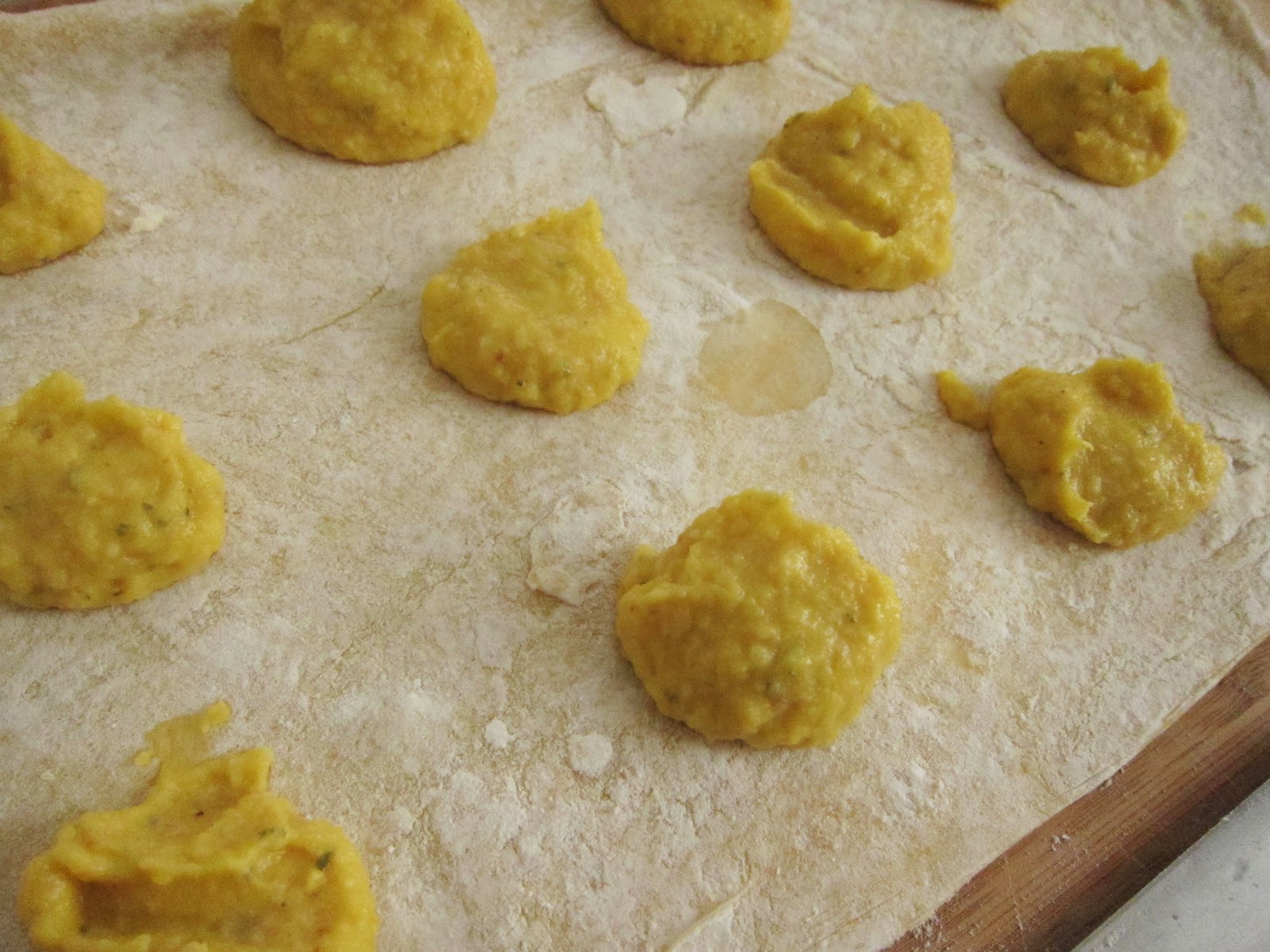
    Lay out one sheet of the pasta and add a spoonfuls of your squash mixture, each about 2 inches apart. Brush a little water on the dough in between.  Lay another sheet of pasta on top and press around each lump of filling with your fingers so that the dough sticks together. Cut your ravioli apart with a knife or pizza cutter.  You want to lay the ravioli out on a tray with some space between them to keep them from sticking together before you cook them.  Boil about three or four at a time, until they float to the top and pucker slightly.

    In a frying pan or hot skillet, melt about 3 tablespoons of butter.  When the butter is hot and melted but not yet brown, add the sage leaves with a generous sprinkling of salt.  Let them fry until they darken and curl.  Drizzle over the ravioli.

    Sunday, June 19, 2011

    Dinner on the Fly: Duck Confit Carbonara with Braised Greens and Garlic Scapes


    I fantasize about a butcher.  Not just the man but the place. No styrofoam, no plastic, just smooth brown paper that creases clean in the corners, folded on a steel countertop.  The man behind the counter would wear a white apron with red stains and an amiable greeting like your friendly neighborhood serial killer.  At some point we would know each other by name.

    I realize that as a New Yorker I have no right to complain about not having access to anything.  It is true that I can get pretty much any exotic ingredient that is worthy of a trip outside my five mile radius (that travel time being equivalent to thirty miles outside the NYC area).  But we can eat just about anything from from grizzly bear to emu to any number of reptiles.  Does anyone ever wonder how we narrowed our choices down to just three; beef, chicken and pork?  In my utopian fantasy, there would be world peace and a neighborhood butcher that sold not just pork, beef and chicken but rabbit, duck, ostrich, bison and something I could try on a dare.  

    We don't eat meat everyday anyway, so our specialty meats are really a treat.  Usually the result of a special outing. Duck, although not high on the list of exoticism, is a rare and coveted dinner at our house.   Especially for a week night.

    Duck Confit

    This is something you make ahead and use sparingly as it is very rich.  It is remarkably easy to for such a fancy sounding name. 
    • 2 duck legs
    • 2 garlic cloves
    • extra duck fat to cover the duck legs
    • tiny sprig of rosemary (optional) 
    You need a oven proof dish that is just big enough to fit your duck legs.  Do not preheat our oven.  Place one garlic clove and rosemary sprig under each duck leg.  Cover almost entirely with extra duck fat.  About one cup to 2 legs.  Put your duck in the oven and turn it on to 250 degrees.  You want the duck in the oven while it is pre-heating.  This is super slow cooking on very low heat.  Leave for 2 to 2 1/2 hours.

    Duck Confit Carbonara with Braised Greens and Garlic Scapes
    • 2 tablespoons duck fat from the duck conft
    • 1 bunch of braising greens such as mustard greens, spinach, kale or chard, chopped
    • 5 garlic scapes
    • 2 eggs
    • 1/4 cup grated grana padana
    • 1 lb of spaghetti
    • Duck meat from confit for serving
    • sea salt
    • freshly ground black pepper
    Salt your water and boil your pasta. Beat your eggs and cheese together Melt your duck fat in a skillet or large sautee pan.  Add your greens and garlic scapes.  If they get a little dry as they are cooking add a little of the pasta water.  When pasta is done add it to your greens if the pan is big enough.  If it isn't you can do the reverse.  Add your egg mixture and toss for a few minutes.  The egg will cook and thicken with the heat of the pasta but not separate. Add salt and pepper to taste.  Serve with duck meat on top.

    Wednesday, December 29, 2010

    The Classics: Frutti Di Mare

    At least for me this is a classic.  Frutti di Mare is my family's traditional dish for Christmas Eve.  It is essentially fish stew over linguini.  Not complicated to make but time sensitive because it involves a fair amount of shellfish.  You don't want to start this dish too early or cook the seafood a little too long.  There is nothing worse than rubbery little mollusks.  Which means you are starting your cooking right after your guests arrive just to make for the start of a hectic holiday dinner.  The up side?  It is worth it!  Every last bright tomato and seafood bite!

    This year I had been wondering about why we Italians have the seafood feast on Christmas Eve.  I never questioned it before because, well, why question a good thing?  The origins come from the Roman Catholic Church where, like on Good Friday (despite this overly optimistic name, it is the day when Jesus was crucified) observant Catholics do not eat meat.  With a little research I found a few possible answers as to why there are seven fishes served for Christmas Eve although none confirmed as true.  The number seven reoccurs in Catholicism.  It took seven days for Mary and Joseph to travel to Bethlehem.  God created the universe in seven days.  The Catholic Church has seven sacraments.  Mortal sins are summarized in the Catholic religion by the following seven: pride, envy, lust, gluttony, greed, sloth and anger. 

    Religious or not, if God (or anyone else) says I need to eat seven types of fish on any day of the year I will not argue. Though preparing one meal with seven fishes is not an easy task.  We are usually shy one or two.  This year we were missing one because a family member is allergic to lobster.  Frutti di Mare is a great way to get as many as you can in one pot.  I am going to recommend a recipe from the Epicurious site that I have used two years in a row.


    Wednesday, December 8, 2010

    To Burundi with Love: Cauliflower Mac and Cheese

    Mac and cheese is the ultimate comfort food (excluding vegans of course). This is another recipe for my dear friend in Burundi, where it appears cauliflower is also plentiful.  During my own short lived vegetarian life, cheese was an important part of my diet, not just for the protein factor but for the decadence factor.  If you can't have meat what would be your next go to when you want to indulge a little?  So I am feeling some serious empathy pangs for Melissa in a country where only one type of cheese is available.

    Still, there is one.  And one that sounds pretty versatile at that.  Melissa mentioned that there is a Congolese cheese that is akin to a mild cheddar.  I usually use three parts of sharp cheddar with one part of a cheese that has a little tang like gruyere or blue.  With a milder cheese, I found that you have more room for a balance of flavors.

    Have your cauliflower chopped and cheese shredded before you start.
    I always start my mac and cheese with a roux.  Melt 2 tablespoons of butter, then add 2 tablespoons of flour and stir rapidly.  This will only take 30 seconds to cook.  Then add 2 cups of milk.  A dutch oven is perfect for this recipe so you can take it from the stove to the oven.
    When your milk is heated, add your shredded cheese a handful at a time.  The amount of cheese you add is to taste.  I just stop adding when I get the thickness I like.  I shred about 6 oz. beforehand.
    I added the cayenne pepper (to taste) and a tablespoon of dijon mustard to the cheese sauce to round out the flavor and give it a little kick.  Bread crumbs are going to give a nice texture later on so keep them on hand.

    Sautee` your cauliflower in a skillet.  I like to use grapeseed oil for sauteeing this, but if your in Burundi, try to use butter.  If you can't use the corn oil and let me know how it turns out.  Add salt and pepper to taste. You will know it is done when it is tender and the edges turn golden.  For the last step toss your cooked pasta and cauliflower into the cheese sauce and mix well.  Then sprinkle bread crumbs to the top and stick under the broiler until the top sets. 
    Mmmmm... What's missing? A beer? 


    Tuesday, October 12, 2010

    Sunday Night at Home: Campanelle with Winter Squash, Pancetta and Sage

    I love the way a winter squash smells when you cut it open.  It smells like trees and the first crisp, cool air of autumn.  I start collecting them this time of year.  Sometimes I have more than I can eat.  Each one is different and they are marvelous.  Secretly they remind me of a Clyfford Stills painting with stripes of green ripping through the yellow or orange bleeding through green.  They are my favorite token of fall.
    I think some tend to shy away from cooking winter squash.  When I was growing up I can remember pumpkin being served but it was strictly Thanksgiving fare and strictly in the form of pie.  I am going to bet here that our pumpkin pies never began with actually peeling a pumpkin but rather opening a can.  During my years as an art teacher, I had annually brought to class an armload of colorful gourds, pumpkin and squash as still life props for painting classes.  (They are wonderful in color mixing lessons I must say!)   Although they were recognizable to everyone, many students didn't know they were edible. ("You mean like jack o'lanterns?  You can eat those?")  

    Truthfully, that hard skin is intimidating.  Then there is the question of what to do with it.  If it isn't normally a household staple than how do you know how to prepare it?  There isn't much you have to do to winter squash actually.  It is naturally sweet and starchy.  Besides, If you can get that puppy peeled the flesh is not so hard to deal with.  It will cut easily and cook quicker than you think.  
    I used what's called a Sunshine Pumpkin (the very orange one in the top picture).  You want to cut the top and bottom off to give you some leverage before slicing through it.  Then go ahead and remove the seeds.
    Cut your squash into chunks.  

    Ingredients:
                                 1 winter squash
                                 2 thick cut slices of pancetta or bacon
                                 1 small bunch of sage
                                 1 red onion (optional, I didn't use it but it might bring out the sweetness in the squash)
                                 salt
                                 pepper
                                 2 tablespoons of olive oil
                                 1/4 to 1/2 cup of milk
                                 1/4 to 1/2 cup of water
                                 grated parmesian cheese 
                                 1 lb. campanelle or other macaroni 
    Heat your olive oil, then add pancetta, onion if you are using it, and cut up winter squash.
    As the squash is sauteeing it is going to start to get dry.  Add liquid (milk and water) as needed.  This will steam them and some will disolve into a creamy sauce.  When the squash begins to soften add chopped sage leaves.
    Toss in your cooked campanelle and top with grated parmesian.