

Let me start by saying that I do not have a pasta machine. I have never had one and I am pretty sure my grandmother didn't either. Saying that doesn't mean that I am opposed to one. I didn't mean that in the belligerent I-will-never-have-one-and-you-shouldn't-either kind of way. Quite the contrary, we would probably have fresh pasta more often if I did have a pasta machine. But you can make fresh pasta without one and it isn't as hard as you think.
Do you remember what it was like to want to get your hands dirty? Or to be a kid and need the satisfaction of a tactile experience? I could not pass a pile of leaves my father had just raked without jumping in it. How about running your fingers through warm sand and digging down to the cool, damp sand underneath? When I was an art teacher my students would ask "When do we get to use clay?" starting on the first week of school and every week that followed until we actually did use clay. They would cheer on painting day from kindergarten to high school.
That is the joy of making something from scratch. It literally feels good. Like cold water and wet clay on a potter's wheel...someone stop me because I will go on forever. Pasta making is like that too except afterwards you get to eat it! If you are really nice you might even share it with others. So what if it took me all day and my kitchen was a mess? Maybe my furniture, counters, hair and eyebrows are covered in flour, but I had fun. Delicious fun.




Roasted Acorn Squash Ravioli with Fried Sage Leaves
For the pasta:
- 3 eggs
- approx. 3 cups of flour
For the filling:
- 1 acorn squash
- 1/4 cup diced pancetta
- 1 tablespoon butter
- 1 small or half of one large onion diced
- 2/3 cup Parmesan cheese
- 5 sage leaves chopped
- salt
- pepper
- 3 tablespoons of butter
- remaining bundle of sage leaves
Preheat your oven to 400 degrees. Wrap your acorn squash in aluminum foil and pop it in. This will roast for about an hour and a half.
On a clean dry surface, scoop out your flour and make it into a pile (like a mountain, as my aunt would say). With your fingers, make a hole in the center (like a valley, if you will). You want to make sure this hole goes down to the surface and that the "walls" are pretty high. Crack one of the eggs into the center of your flour. Gently scramble the egg with a fork. it will begin to absorb the flour. When it becomes more of a cough you can begin to knead it with your fingers. Form the dough into a disc and repeat with the following two eggs.
On a floured surface, roll out your dough from the center out. The flour is what makes the dough expand so if the dough is too sticky or not spreading, add more four to the surface. Roll out the dough as thin as you can get it without breaking.
On a floured surface, roll out your dough from the center out. The flour is what makes the dough expand so if the dough is too sticky or not spreading, add more four to the surface. Roll out the dough as thin as you can get it without breaking.
In the meantime, you might want to get started on the filling. Add your butter, pancetta and onion to a hot skillet. Turn down the heat to medium and sautee` your ingredients until your pancetta is well cooked and your onion is translucent. Salt and pepper to taste
When your acorn squash is done, take it out, unwrap it, cut it in half and let it cool. When it is cool enough to handle, scoop out the seeds and throw them away. Then scoop out the flesh with a spoon. Add the squash, pancetta and onion mixture, chopped sage and Parmesan cheese to a food processor and pulse until smooth. (Or mash it together with a fork if you prefer.)
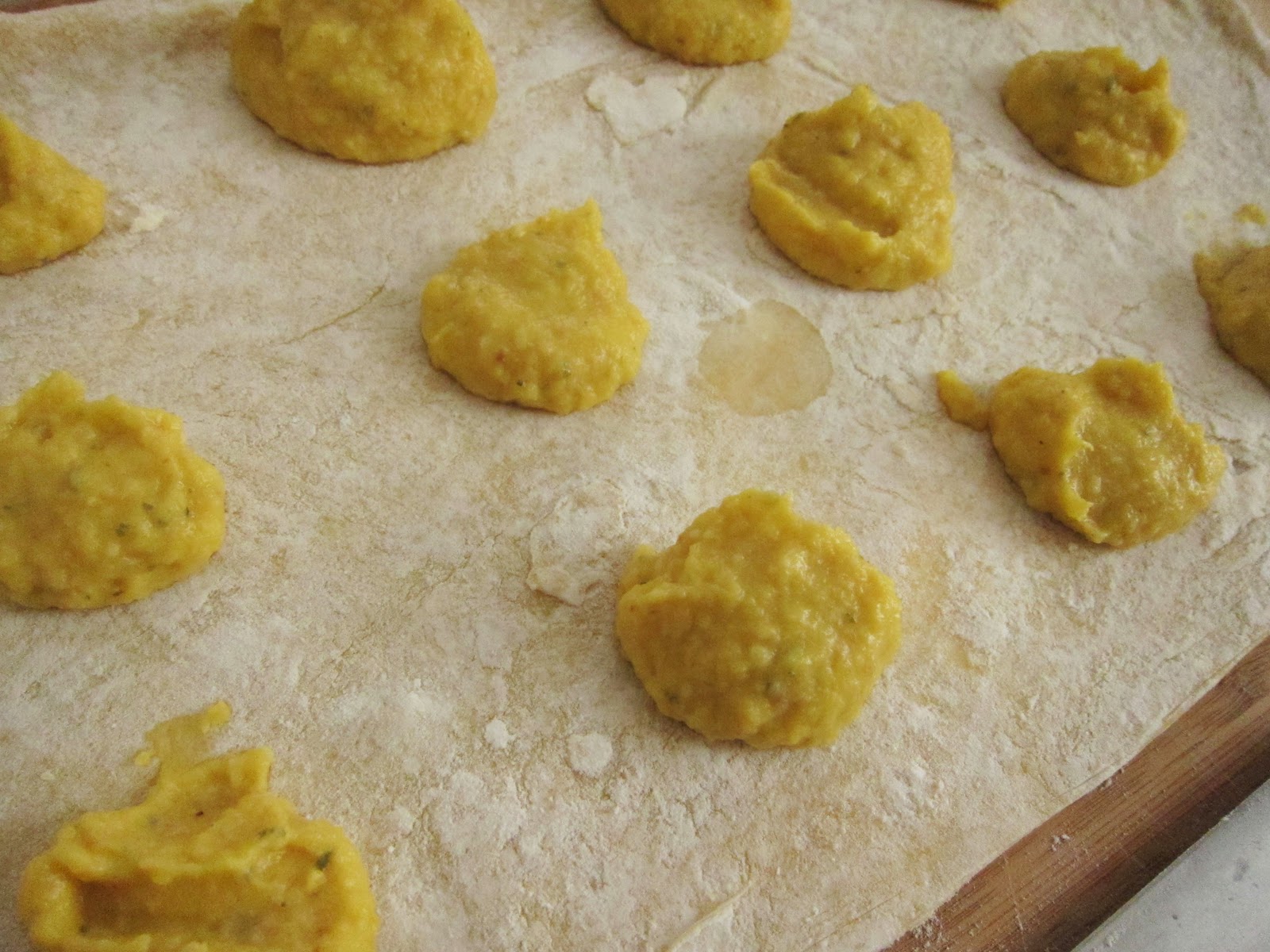
Lay out one sheet of the pasta and add a spoonfuls of your squash mixture, each about 2 inches apart. Brush a little water on the dough in between. Lay another sheet of pasta on top and press around each lump of filling with your fingers so that the dough sticks together. Cut your ravioli apart with a knife or pizza cutter. You want to lay the ravioli out on a tray with some space between them to keep them from sticking together before you cook them. Boil about three or four at a time, until they float to the top and pucker slightly.
In a frying pan or hot skillet, melt about 3 tablespoons of butter. When the butter is hot and melted but not yet brown, add the sage leaves with a generous sprinkling of salt. Let them fry until they darken and curl. Drizzle over the ravioli.


