Monday, July 25, 2011

Dinner on the Fly: Stuffed Zucchini Boats

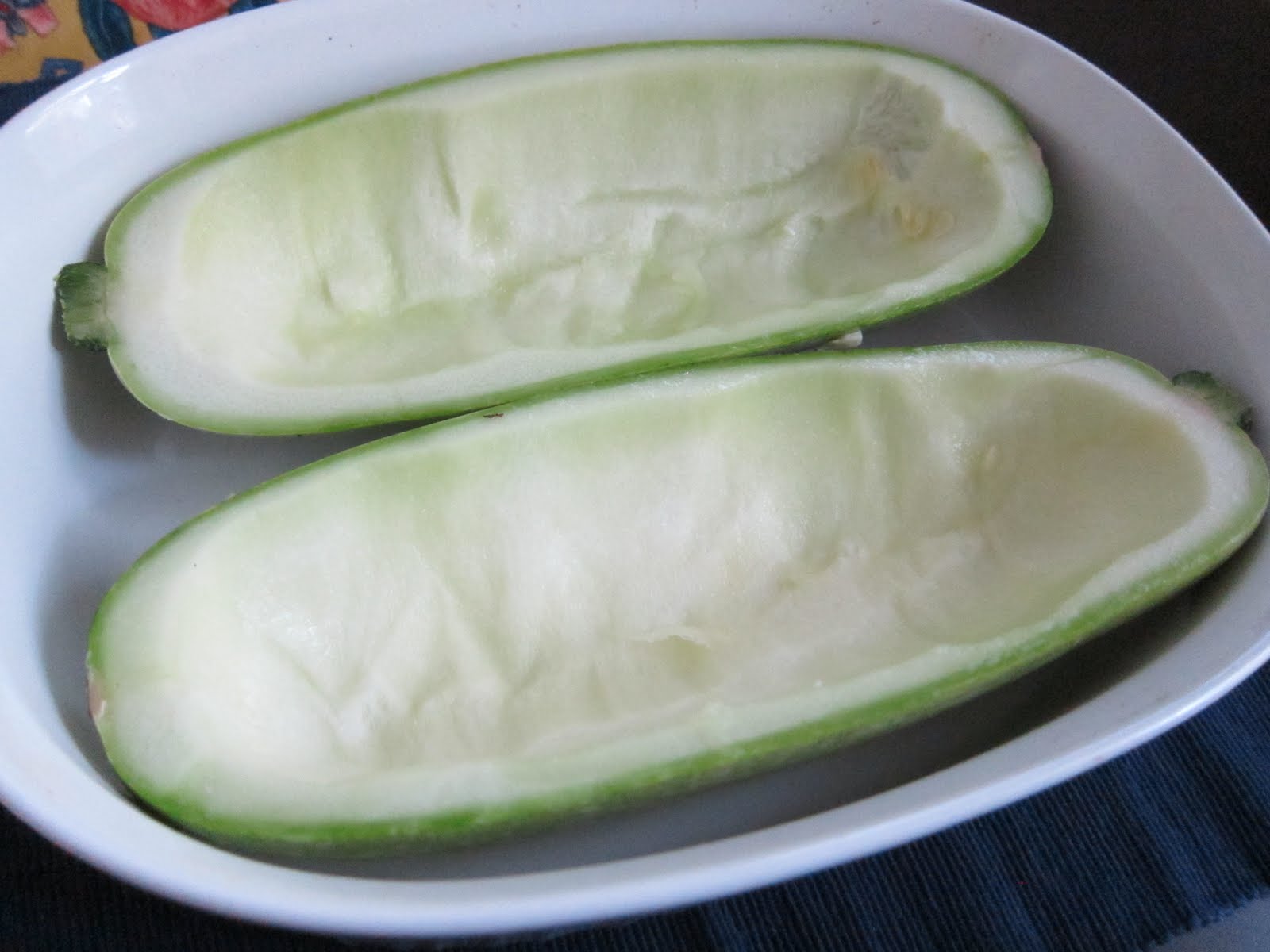
Zucchini here, zucchini there, zucchini, zucchini everywhere. Our local CSA is in full swing and zucchini season it is.  How many ways can I make this stuff?  What to do when your zucchini is the size of a small watermelon? Well, summer isn't all brisket and hamburgers now, is it?  I still fairly new at stuffing vegetables but this recipe is easy.  I think it is worth experimenting with, use different cheeses and herbs, maybe add a meat for something a little more filling.

Stuffed Zucchini Boats

1 large 2 small zucchini 
2 garlic cloves minced
1 onion, chopped
3 plum tomatoes, chopped
A handful of basil leaves chopped or torn
Juice of one lemon
1 cup cooked rice
1/4 to 1/2 pound feta cheese
1 tablespoon maras biberi (Turkish red pepper)
1/4 cup pitted black sundried olives
light sprinkling of sea salt
Drizzle of olive oil

Preheat your oven to 475 degrees.   Scoop out the insides of the zucchini with a spoon or melon baller. Drizzle a little olive oil inside the holllowed out zucchini.  Chop and put aside in a large bowl.  Add all remaining ingredients to the bowl with chopped zucchini and toss.  Drizzle a little more olive oil in the mixture and bake until tender.  About 35 to 45 minutes.


Saturday, July 16, 2011

Community Table: Nick's Barbecue Brisket

I have never seen a man seem so perfectly in his element than my husband, Nick, grilling barbecue brisket.   Maybe grilling is the wrong word.  It is an all day barbecue, with a beer in hand.  Over the years I will admit that I have monopolized the kitchen. But on brisket day I surrender my kitchen haven and, unless specifically called upon, my nosy interjections, to Nick and his process.  If you are a regular reader of this blog, I have given you glimpses of this succulent meat, but not until now have I been able to give up the recipe.   It is only after 4, nay 5 attempts at perfection that I am allowed to document it.  Sometimes Nick's complaint is a less than perfect texture, but searching for the perfect balance of spices has also taken some time.  Nick resembles some sort of mad scientist or potion maker mixing and measuring condiments and spices.  Then it is a 6-8 hour process  of slow cooking this meat on the grill, frequently checking that the temperature doesn't get too high.  It's like Atlas holding up the sun and drinking beer with his other hand.

It all starts with a good cut of meat.  This one is from Brooklyn Kitchen.

Here you need to trim the layer of fat around your brisket until it is about 1/4 to 1/8 of an inch thick.


Nick's Slow Cooked Barbecue Brisket
  • a 3 to 4 pound beef brisket
  • canola oil
  • apple juice
For the Dry Rub:
  • 1/8 cup garlic salt
  • 1 1/2 teaspoon ground black pepper
  • 1 teaspoon kosher salt
  • 1/2 teaspoon cayenne pepper
  • 1 tablespoon chicory coffee (like Cafe Du Monde brand)
For the Wet Rub:
  • 1 1/2 tablespoon ground mustard
  • 1 1/2 tablespoon Worcester Sauce
For the Wrapping Mixture:
  • 1/4 cup maple syrup
  • 1/4 cup brown sugar
  • 2 tablespoons butter 
*The technique for this brisket is adapted from Adam Perry Lang's book Serious Barbecue.  Adam Perry Lang is owner and chef of Daisy May's BBQ.
  1. Mix your seasonings in three separate bowls.  Add you wet rub to the meat and then the dry.  let sit for 1 hour.
  2. Preheat your charcoal grill with a packet of hickory wood chips to 275 degrees.
  3. Using your hands or a brush, evenly, but lightly coat the brisket with canola oil.  Insert a remote thermometer in the thickest part of the brisket. 
  4. Put your brisket on the cooker with the fat side down.  After 2 hours, spray every hour with apple juice.   Cook until the internal temperature reaches about 165 degrees, should take 6 1/2 to 7 hours.
  5. Lay out two sheets of aluminum foil (heavy duty is probably best), put you brisket on top, and pour your wrapping mixture over it.  Wrap it up securely and reinsert your thermometer.  Put back on the grill and cook until the internal temperature is 195 degrees.  Should take 2 to 2 1/2 hours.
  6. Line a small cooler with an old, clean beach towel for insulation.
  7. Remove your brisket form the grill and carefully unwrap over a baking dish or disposable pan, reserving the liquid.
  8. Lay out 2 more sheets of aluminum foil and put your brisket on it.  Over a measuring cup, strain the reserved liquid from the baking dish through a fine mesh strainer.  Discard the solids.  Allow the fat to come to the top, pour off and then discard.  Pour the defatted liquid onto the brisket.  Wrap your aluminum foil around your brisket place in a disposable pan or baking dish and transfer to cooler.  Cover with towel, close the lid and let rest for 1 hour.  When the brisket has rested for 30 minutes, increase your cooking temperature to 300 degrees.
  9. Place your meat back on the grill for 30 minutes.
  10. Cut your meat on a cutting board.  Make sure you cut against the grain.  Lang says to let it rest 10 minutes, but so far we have not been able to show that kind of restraint.


Sunday, June 19, 2011

Dinner on the Fly: Duck Confit Carbonara with Braised Greens and Garlic Scapes


I fantasize about a butcher.  Not just the man but the place. No styrofoam, no plastic, just smooth brown paper that creases clean in the corners, folded on a steel countertop.  The man behind the counter would wear a white apron with red stains and an amiable greeting like your friendly neighborhood serial killer.  At some point we would know each other by name.

I realize that as a New Yorker I have no right to complain about not having access to anything.  It is true that I can get pretty much any exotic ingredient that is worthy of a trip outside my five mile radius (that travel time being equivalent to thirty miles outside the NYC area).  But we can eat just about anything from from grizzly bear to emu to any number of reptiles.  Does anyone ever wonder how we narrowed our choices down to just three; beef, chicken and pork?  In my utopian fantasy, there would be world peace and a neighborhood butcher that sold not just pork, beef and chicken but rabbit, duck, ostrich, bison and something I could try on a dare.  

We don't eat meat everyday anyway, so our specialty meats are really a treat.  Usually the result of a special outing. Duck, although not high on the list of exoticism, is a rare and coveted dinner at our house.   Especially for a week night.

Duck Confit

This is something you make ahead and use sparingly as it is very rich.  It is remarkably easy to for such a fancy sounding name. 
  • 2 duck legs
  • 2 garlic cloves
  • extra duck fat to cover the duck legs
  • tiny sprig of rosemary (optional) 
You need a oven proof dish that is just big enough to fit your duck legs.  Do not preheat our oven.  Place one garlic clove and rosemary sprig under each duck leg.  Cover almost entirely with extra duck fat.  About one cup to 2 legs.  Put your duck in the oven and turn it on to 250 degrees.  You want the duck in the oven while it is pre-heating.  This is super slow cooking on very low heat.  Leave for 2 to 2 1/2 hours.

Duck Confit Carbonara with Braised Greens and Garlic Scapes
  • 2 tablespoons duck fat from the duck conft
  • 1 bunch of braising greens such as mustard greens, spinach, kale or chard, chopped
  • 5 garlic scapes
  • 2 eggs
  • 1/4 cup grated grana padana
  • 1 lb of spaghetti
  • Duck meat from confit for serving
  • sea salt
  • freshly ground black pepper
Salt your water and boil your pasta. Beat your eggs and cheese together Melt your duck fat in a skillet or large sautee pan.  Add your greens and garlic scapes.  If they get a little dry as they are cooking add a little of the pasta water.  When pasta is done add it to your greens if the pan is big enough.  If it isn't you can do the reverse.  Add your egg mixture and toss for a few minutes.  The egg will cook and thicken with the heat of the pasta but not separate. Add salt and pepper to taste.  Serve with duck meat on top.

Sunday, June 12, 2011

Finding Eggs and Shelling Beans


I was eight and my brother was four when we were introduced to our grandparents.  It was the first summer of many we spent in the mountainous region of Southern Lazio, Italy where our father is from.  It was a long, stuffy journey for us but the air got progressively cleaner and thinner as we got closer to our destination.  By the last fifteen minutes of the journey, we were riding in a car circling higher and higher up mountains.  Birds were our traveling companions.  My father became more animated as what looked like a birthmark on the mountain grew to be recognized as a cluster of stone residences that was his town.  A far cry from Yonkers.

My father had told me that my grandparents kept chickens, picked fruit off of trees and harvested olives with the help of their neighbors from their own olive groves.  My fourth grade textbook education translated that to 'They live on a farm.'  Rural to the average American eight year old is a ranch style house and rolling acres of land around it, like in a picture book called "Where Does Our Milk Come From?". When we pulled up to the large wooden doors of a stone facade that seemed to be attached to every other stone facade in the town, I thought we could not possibly be in the right place.

"Why are we stopping here?  When do we get to Nonna and Nonno's house?"
My father laughed in a way that was both amused and excited, and exclaimed, "We are here!"

Here we were.  In the midst of a reunion, my brother and I are presented with pride to our grandparents.  There were big exclamations, gesticulations, tears, smiles and checks pinched purple.  My grandmother had a cloud of snow white hair, a fixed demure smile with chin tilted inward, and broad palms that cupped our faces in a basket embrace.  If the barrior of her dialect had not existed, one would still have to lean in close to hear the soft, high pitch bell of her voice.  My grandfather was short and stout with a chest that puffed out like a pigeon.  His shoulders were broad as was his upward, tilted smile.  In contrast, one would never have to lean in to hear him.

Fascinated and timid, I was determined to be on my best behavior.  Yet, I felt idle and mute in this new place were I struggled to understand and be understood.  I shadowed my new grandmother around her home.  I found her at the sink in the mornings. "Cosa vuoi mangiare? L'uova?" What would you like to eat? Eggs?  She asked me to retrieve them.  There were no eggs in the refridgerater.  My father is chuckling in the doorway.  "The eggs are outside in the yard."  Down the marble stairs and out the back door is a small yard with a chicken coup to the right.  I stepped inside to loud squawking and feathers flapping around my feet. I walked gingerly through my egg hunt.  I held up a smooth, brown globe.  Triumphant and beaming I ran back to the kitchen.

In the afternoon, we sat on folding chairs with a bucket of bean pods between us.  She taught me to split the pods with my thumb to reveal the beans inside.  They were glossy white speckled with purple patches like artisan beads. Her rounded hands worked nimbly leaving a pile of empty pods in her apron while my small fingers worked clumsily, barely making a dent in her afternoons work.

Without words but with shared activity I got to know my grandmother, her lifestyle and routine.  The routine that made her matriarch and care taker of all those who entered her home, friends, family and neighbors.  During that first summer away from the familiarities of suburban New York, I never asked for a peanut butter and jelly sandwich or an oreo cookie.

No recipe today.  Just a  photo that triggered a memory to remind me why I cooked today and will cook again tomorrow.

Saturday, June 4, 2011

The Classics: Baked Beans

Another summer barbecue, classic side dish.  This side is so easy that I can not believe I have ever eaten it out of a can.  ( I also can't believe I just admitted that to you.)  This past grilling endeavor on my husband's part was a great opportunity to for me to make baked beans as a side in place of the potato salad.  This is such a staple of American casual cuisine in my mind.  However, during a brief time I spent as a traveler with a work visa in England, I had it as an integral part of their traditional "English Breakfast." Cheerfully referred to as "beans on toast", this meant a can of Heinz baked beans, warmed and dumped over white, sliced bread toast.  I was a little disappointed when it was first served to me but then it fit my young traveler's budget and morning appetite.  It was equivalent to an "egg-on-a roll" that you can get at any New York bodega for $1.99.

A far cry from Heinz baked beans in a can, I am very happy with the way this recipe turned out.  It has that traditional sweetness along with a little added spice.


Baked Beans
  • One 16 oz bag of dry white kidney beans
  • 1 large onion, chopped
  • 1/4 pound of slab bacon (go to a butcher, please), diced in small cubes
  • 1/4 cup molasses
  • 1/4 of a cup light brown sugar
  • 2 tablespoons apple cider vinegar
  • 2 tablespoons ground dry mustard
  • 1 bay leaf 
  • 2 to 3 tablespoons of tomato paste
  • dash of chipotle powder (optional but it adds to the smokey flavor with just a touch of heat)
  • salt and pepper to taste
I start my beans in the slow cooker on high for about 30 to 45 minutes with enough water to cover them with an inch of water above the beans.  If you don't have a slow cooker you can put them in a large pot with the same amount of water to simmer.  In a large dutch oven or cast iron pot, cook your bacon and onion until your onion is translucent and your bacon is starting to brown.  Drain your beans and add them to the pot. Toss so that they are coated with bacon fat.  Add all other ingredients and toss.  Cover with water and bring to a boil.  Then simmer until the beans are tender, about 2 1/2 hours.

Just for inspiration, I have to show you our complete meal.

On the left is a spicy, no-mayo slaw with red cabbage and carrots, and below is Nick' slow cooked, barbecue brisket.

If Nick ever decides to share this recipe it could be a future blog post.


Wednesday, May 18, 2011

The Classics: Potato Salad (Greenpoint Style)


At our house, the first warm day that my husband takes out his grill is potato salad season.  I love a good potato salad particularly because it is such an easy side for a casual get together.  One labor day I brought it to a luncheon at a friend's family beach house in the Rockaways.  Her grandmother was so full of compliments I felt like a Domestic Potato Salad Goddess for the day.  Really, I think I just got lucky.  Two uninspiring batches of potato salad later and my domestic goddess status was demoted.

The ingredients in my potato salad are like commas in my writing attempts.  I just, don't know, when, I have too many, where, to put them in, or when, to leave them out.  Like all cooking, art and life (it alway comes to that), the priority has to be balance, then all the ingredients fall into place.  The formula: potatoes, one or two crunchy vegetables, one or two flavor boosters like onion, hot pepper, or capers, a choice of meat, egg or fish, an herb or spice, and a dressing to serve as a binder, most commonly mayonaise or oil paired with an acidic flavor.  More than that and I have not been successful.  The flavors just don't shine through.

So if I haven't mentioned this before, Nick and I live in Greenpoint, Brookyn.  This is a well established Polish community with distinctly Polish flavors up and down (and in between) our main drag.  This suits me and my Polish-American husband just fine, especially when we are craving some comfort food in form of a smokey fish or meat.  The morning of this potato salad, a neighbor brought us a beautiful, rich coral orange steak of smoked salmon from Acme Smoked Fish.  Sadly. I have never been able to go myself as they are only open for public retail on Friday mornings.  Ah, the limitations of a day job.  Thinking of playing hooky anytime soon? Maybe for an exceptional smoked salmon experience?   Needless to say, some if it made it into our potato salad and the rest, well, got devoured as is and with our fingers.


Potato Salad Greenpoint Style with Smoked Salmon

5 or 6 potatoes cubed
2 to three scallions (I like to use only the greens) chopped
3 radishes chopped
A handful of the chopped radish greens*
2 teaspoons capers
3 1/2 inch cut of smoked salmon steak diced
sea salt to taste
black pepper to taste
1/2 cup mayonaise
2 tablespoons dijon mustard
2 glugs of olive oil
juice of one lemon

Boil your potatos in salted water until tender but not mushy.  You want them to be soft when your fork goes through but not to fall apart.  Then drain.  In a large bowl, toss your chopped radishes, radish greens, scallions, smoked salmon and capers,  In a small bowl, whisk together mayonaise, mustard, olive oil, and lemon juice with a little salt and pepper.  I like to add the potatoes while they are still very warm but not steaming hot.  I would recommend letting them cool for 7 to 10 minutes.  The hotter they are the more they will absorb your dressing.  You want them to absorb some of the dressing but not so much so that the other ingredients don't get enough.  Finish with another sprinkling of sea salt and black pepper.
*I often reserve the greens of a root vegetable to use in a dish like I would parsley.  Why waste it when it is tasty and delicious?

Sunday, May 15, 2011

Artful Brunch: Scones


Before I decided that I liked eating scones, I liked the word scone.  I like how the sound pours out of your mouth long and low like a church bell.  I also liked the idea of a scone, evoking cloth napkins and china tea cups.  Although what was a beautiful, auditory sound for me was paired with a dry, sandy mouthful of lumpy bread.  This was made worse one unfortunate weekday morning when, in a groggy, decaffeinated state, I convinced myself that it would be a good idea to get a scone at Starbucks.  Still dry, lumpy bread but with too much sugar.

But still, I was not ready to give up on the romanticized vision of china teacups.  And the word scone falling off the tongue easier than, let's say, pancake.  Not that I have anything against pancakes. Particularly if they are made with buttermilk and plump with blueberries (Janice!).  And I will say it, I didn't like pancakes until I had them made that way.  Proving yet again that it isn't the food alone but the approach.  Brunch, like all of life's simple pleasures, should be artful.

The first batch of scones I made were my best scones.  Back in the fall, after a very ambitious day of apple picking that became the inspiration to many an apple laden recipe (see here), I made apple cheddar scones.  These were adapted from a recipe in "Once Upon a Tart" by Frank Mentesana and Jerome Audureau.  I came upon this lovely little cookbook quite by accident.  Or rather I should say that my mother came across this book in the library she was working in.  I came to learn that this little cafe is located on Sullivan St. in Manhattan and if you are in the neighborhood it is most certainly worth a visit.

Back to the scone recipe.  My scone adventure began with a simple recipe for Cheddar-Parmesan Scones with Fresh Dill.  I was first intrigued by how simple the recipe was.  I didn't even have to take out my Kitchenaid mixer.  How could it hurt? I swapped out the Parmesan, cayenne and dill for apples, being that I had about a bushel on hand anyway.  The result was not dry, but a delicately balanced, sweet and savory,  steamy cloud of bread that drank butter when you spread it on.  I thought that perhaps it was the apples that balanced out the texture but I have since made a few versions without that were almost as soft.  (The apples do help a little.)  My most recent version of this scone was closest to the original.  But the recipe is so adaptable that you can find any combination of sweet or savory additions to make this work. Something to remember is that if the flavor you are adding is moist by nature it adds to that fluffy, soft, texture in your scone.  The book does have a variety of scone recipes, all were the ratios are different depending on the types of ingredients being used, and is worth checking out (for other things too).  My sincere thanks Frank and Jerome!

Cheddar-Asiago Scones with Chives
(adapted from Once upon a Tart by Frank Mentesana and Jerome Audureau with Carolynn Carreno)

2 2/3 cups unbleached all-purpose flour
1 tablespoon baking powder
1/2 teaspoon salt
1 stick of butter, cut in 8 pieces
3 large eggs,
1/2 cup cold milk
2 tablespoons chopped chives
2 cups cheddar cheese
1/3 cup grated asiago

Position one of your oven racks in the center of your oven and preheat your oven to 400 degrees. Line a baking sheet with parchment paper.   Dump the dry ingredients into the bowl of a food processor and pulse so that they are mixed evenly.  Add the butter run your food processor for 15 seconds.  Continue to pulse if there are still chunks of butter.  It should look a little like bread crumbs. Then dump the mixture into a large bowl.  In a smaller bowl, whisk the eggs o break the yolks.  Whisk in milk followed but chives and cheeses.   Then pour the wet ingredients in with the dry and stir with a wooden spoon.  Note that it will seem very dry at first but it will come together.  Once you have a dough- like consistency scoop  up about a 1/2 cup of it in your hands and plop in on the parchment paper.  They should be about 2 inches apart.  Bake for 20-25 minutes, until the tops are golden brown and a toothpick comes out clean.